20 Conference Attendee Questions Your Signage Should Answer
Every conference runs an unofficial survey, all day long, and nobody writes it down. The twenty conference attendee questions below come straight from the info-desk canon, and most events still answer them with a folded map and two exhausted volunteers.
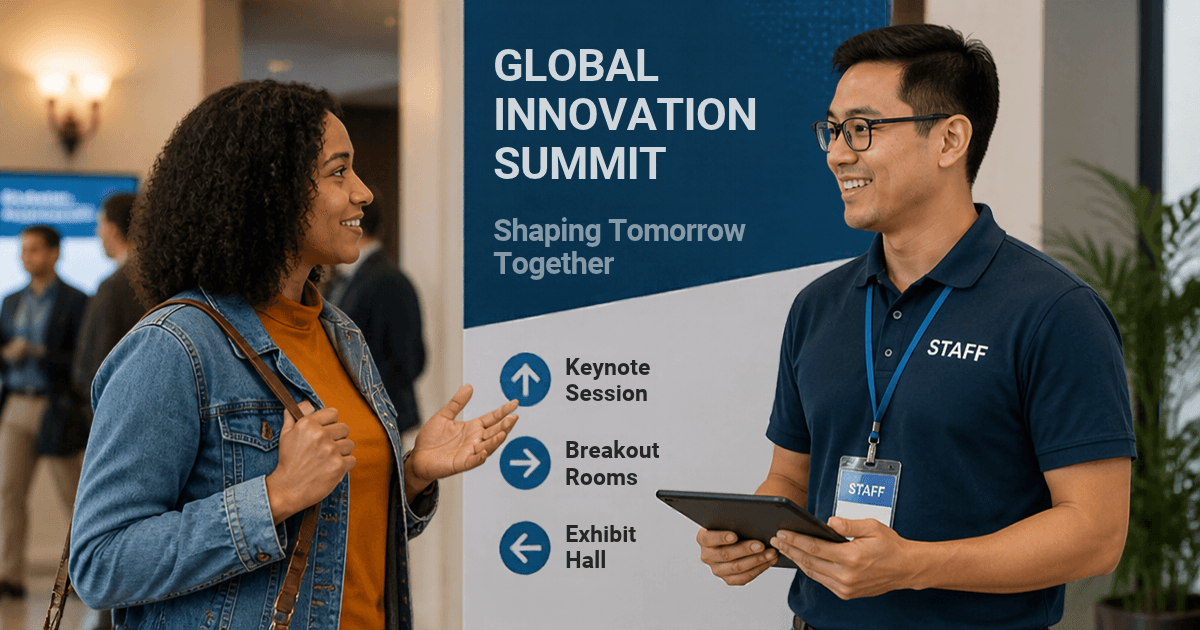
The survey gets spoken at whoever looks official (a volunteer, a staff lanyard, a person standing near a door). Read as a list, the questions are a diagnosis: each cluster points at a specific breakdown in how the event communicates, and half of them say something unflattering about the signage budget.
Where, When, Who: The Wayfinding Cluster
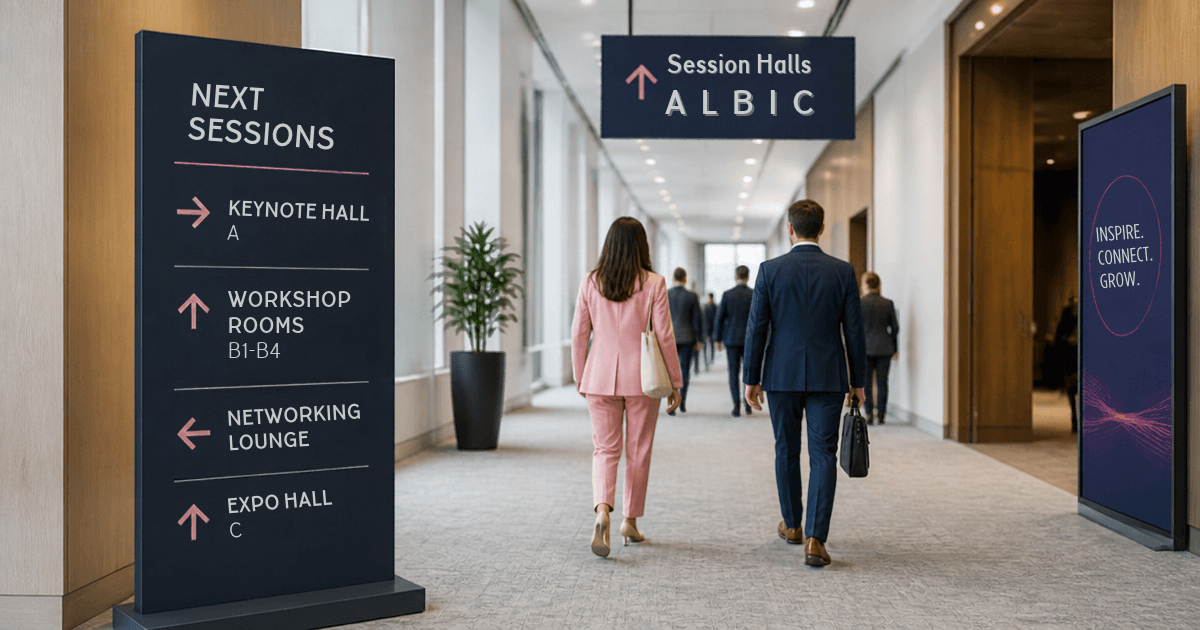
The first five questions are about physical space, and they start the moment badges hit lanyards:
- “Where's the keynote hall?”
- “How do I get to the annex across the street?”
- “Which exit is closest to the rideshare pickup?”
- “Where's the nearest restroom that isn't a ten-minute walk?”
- “Where's room 204B? The numbering makes no sense to me.”
Five questions, one root cause: attendees can't see the building the way the floor plan does. A sign at every turn is impossible, so events over-sign the lobby and under-sign everything past it. The tells are in the phrasing: nobody asks where the keynote hall is if a sign said “Keynote →” within fifteen seconds of where they started looking.
What's Happening Now: Schedule and Session Questions
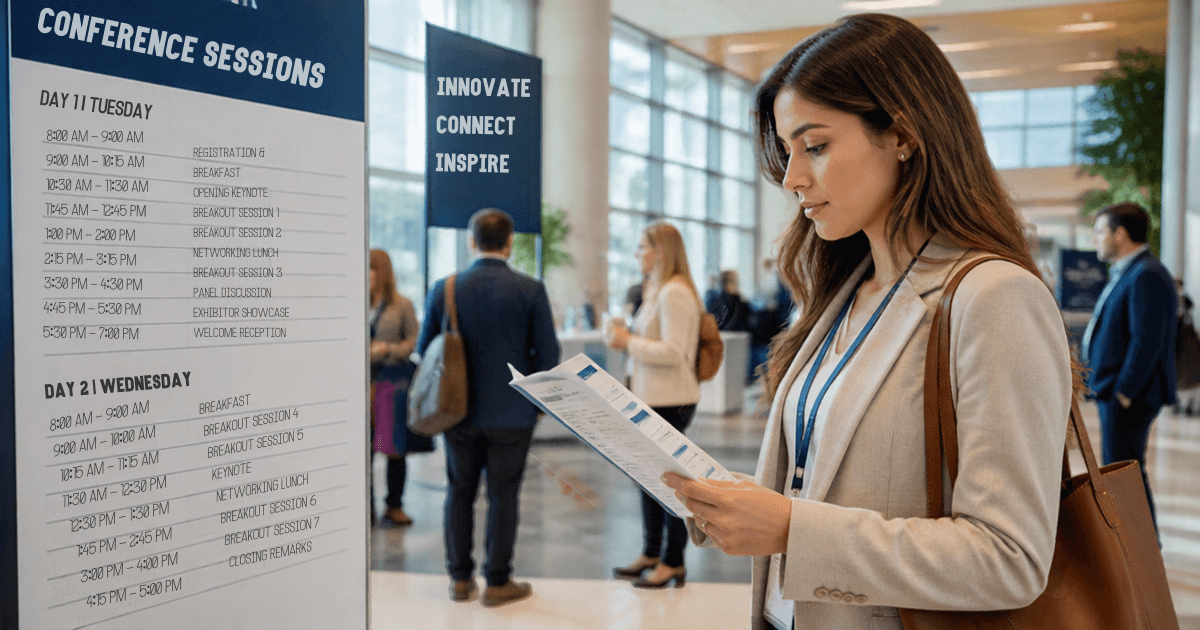
The second cluster is about time, and it's where paper quietly fails:
- “What sessions are happening right now?”
- “Who's speaking at 2 PM?”
- “Is the 3 o'clock panel still on? I heard something changed.”
- “Where do the slides or recordings land afterward?”
- “Which track fits someone who does what I do?”
A printed program describes the morning as planned. By lunch it's fiction: rooms move, speakers swap, a session runs long and drags the whole afternoon with it. Questions six through ten are the sound of attendees trying to reconcile a paper schedule with a building that has moved on. Every “is it still on?” is a small vote of no confidence in whatever board they last checked.
Food, WiFi, and the Comfort Block

Then the logistics block, which arrives in a burst right before every break:
- “Where can I get lunch?”
- “Is there anything gluten-free, or should I plan around it?”
- “What's the WiFi password?”
- “Where can I charge my phone before the afternoon session?”
- “Is there coffee after 3, or is that it?”
None of these is hard. All of them peak at the same hours, which means the same four staff members answer them forty times between 11:45 and 1:15. A sign by the food hall door helps the people already standing next to it. It does nothing for the attendee on the third floor deciding whether the lunch line is worth the elevator trip.
The Questions No Signage Can Answer
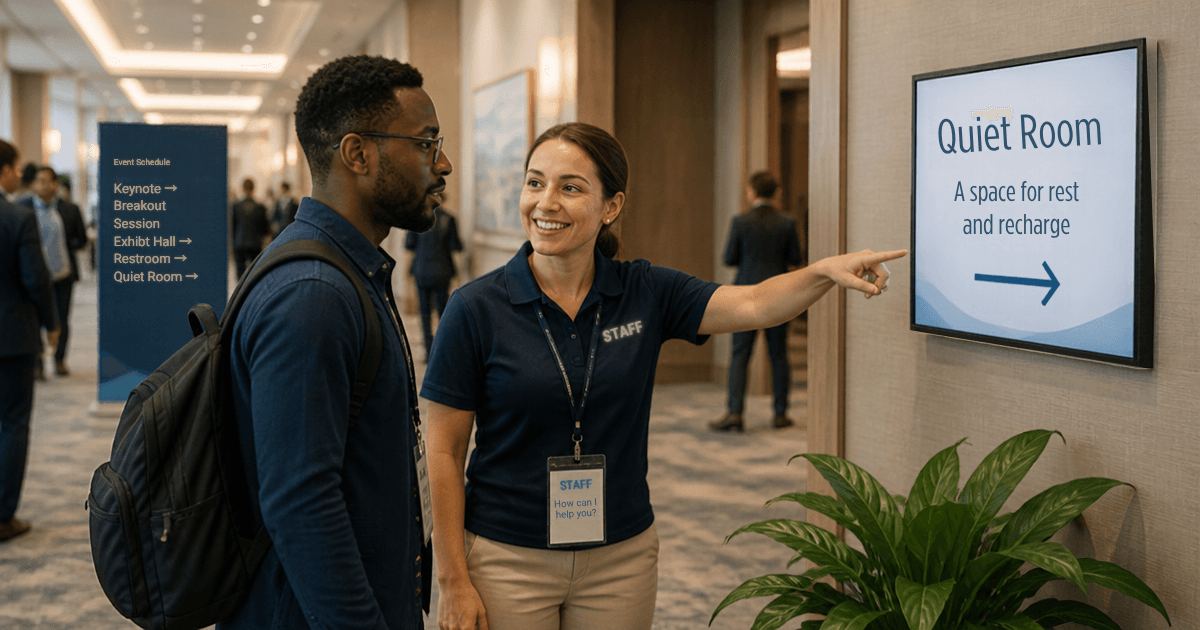
The last five are different in kind, not degree:
- “Where can I take a call without everyone hearing it?”
- “Is there a quiet room anywhere?”
- “I lost a jacket sometime this morning. Where's lost and found?”
- “Is there a first-aid station?”
- “Can someone check whether the 4 PM workshop still has space?”
These can't be pre-printed because they depend on state: what time it is, what's happened, what the room counts look like. No sign knows the workshop has three seats left. No banner knows where the jacket is. These are the questions that pull your best volunteer off the floor for twenty minutes apiece, and they're also the ones attendees remember when they describe how the event “felt,” because each one arrived at a moment of mild personal need.
What Conference Attendee Questions Say About Your Signage

Treat the twenty as an audit, because they are one. Questions one through five measure sign placement: if a cluster keeps forming at the same corner, the missing sign isn't more signage, it's one sign at the decision point six meters back. Questions six through ten measure whether your schedule channel keeps up with reality. The comfort block measures whether the answers live where attendees physically are when the questions occur to them.
The honest conclusion is that signage solves the static half of the list and cannot solve the moving half. Paper can point at the keynote hall forever. Paper cannot say the panel moved, that the workshop has space, or that the quiet room is down the hall and to the left of registration. Events that answer well run two systems: signage for the constants, and a live answer channel for everything that changes. Organizers already running that second system lean on the AI tools that help conference organizers communicate with attendees via text.
Answering the Long Tail: Where an Event AI Assistant Fits

The live half is where an event AI assistant earns its keep. AI Ambassador answers the moving questions in seconds (what sessions are happening now, where the keynote hall is, who's speaking at 2 PM, where lunch is) from one assistant that scales from 50 attendees to 50,000+. Attendees connect by scanning a QR code, with no app download and no account, and the conversation happens in the messaging app already on their phone. For international crowds the exchange runs in the attendee's own language, detected automatically across 126 languages.
The guest-experience effect compounds. An attendee who got a straight answer in eight seconds stops queueing at the info desk for the next one, which shortens the line for the person behind them and frees staff for the judgment calls no assistant should make. Same building, same schedule chaos, but the questions stop collecting in a pile in front of two volunteers. That compounding shows up in deployments like SAM's return to Seed the South: how SAM boosted conference engagement with just a text.
Frequently Asked Questions
What questions do attendees ask at conferences?
Five clusters, in practice: wayfinding (rooms, exits, restrooms), schedule (“what's happening now”), content (speakers, slides, recordings), logistics (food, WiFi, charging), and situational needs (quiet rooms, lost and found, first aid). The first three dominate the info desk; the last cluster carries the most emotional weight because it shows up when something has gone wrong for that attendee.
How do I stop answering the same questions at events?
Split the list. Put the static answers on signs at the decision points (not clustered in the lobby) and audit placement against where questions cluster. Then give the moving questions a live channel: a staffed desk, or an event AI assistant that attendees reach by scanning a QR code. Brief the floor staff each morning on what changed, so the human answers and the system answers agree.
Does an event AI assistant replace an info desk?
No, and it shouldn't. The assistant absorbs the repetitive volume (schedules, directions, the WiFi password) instantly and at scale, so the desk stops being a queue and becomes what it was meant to be: staff handling exceptions, escalations, and the attendee having a bad day. Most events run both, and the desk gets noticeably quieter within the first morning.
Bring the List of Twenty to Your Next Event
See how AI Ambassador answers attendee questions in seconds: request a demo and bring the list of twenty to your next event.